
The Industrial Workhorse: Understanding the Shift to 12K Carbon Fiber
In the hierarchy of composite reinforcements, 3K carbon fiber often steals the spotlight with its iconic weave and high-detail aesthetics. However, for manufacturers moving from prototyping to industrial-scale production—whether in marine hulls, wind turbine blades, or large-format automotive panels—the economics of 3K fabric quickly become a bottleneck. This is where 12K carbon fiber fabric enters the conversation. Understanding the nuances of “Large Tow” economics is essential for any production manager looking to optimize their cost-per-kilogram without sacrificing structural integrity. To understand where 12K fits in the wider manufacturing landscape, visit our Ultimate Guide to Carbon Fiber.
When we talk about “12K,” we are referring to the number of individual filaments in a single bundle (or “tow”). A 12K tow contains 12,000 filaments, compared to the 3,000 found in 3K. While the chemistry of the carbon itself remains the same—often based on the industry-standard T700 precursor—the physical size of the tow changes the behavior of the fabric, the speed of layup, and, most importantly, the bulk pricing structure.
Tow Size and Industrial Economics: Why 12K is Cheaper
A common question in the workshop is: “If the fiber is the same, why is 12K significantly cheaper than 3K?” The answer lies at the carbon fiber production plant. Producing a 12K tow takes roughly the same amount of time and energy as a 3K tow, but it yields four times the weight of material. For the fiber manufacturer, 12K is more efficient to produce. For the weaver, 12K fabric requires fewer “picks” (insertions of the weft yarn) to cover the same surface area, which reduces loom time and labor costs. For a deeper breakdown of material costs, read our Fiberglass vs Carbon Fiber Cost-Benefit Guide.
When buying in bulk, 12K fabric typically offers a 20% to 40% cost saving over 3K for equivalent aerial weights. In industrial laminates, where you are consuming hundreds of kilograms of material, this difference determines whether a project is profitable or a loss leader. However, 12K isn’t just about saving money; it’s about “building thickness” faster. A single layer of 12K 400gsm fabric replaces two layers of 200gsm 3K, effectively cutting your layup labor in half.

The Spread Tow Revolution: Lightweight 12K
One of the most exciting developments in 12K technology is “Spread Tow.” Traditionally, 12K fabric was heavy and bulky (often 400gsm to 800gsm). But by using mechanical spreaders to flatten the 12,000 filaments into a wide, thin ribbon before weaving, we can now produce 12K fabrics as light as 80gsm. This provides the economic benefits of large tow fiber with the lightweight performance usually reserved for expensive 1K or 3K “space-grade” fabrics.
Spread tow fabrics are flatter than traditional weaves. This means the fibers have less “crimp” (the up-and-down undulation of the weave). Straighter fibers mean more of the carbon’s tensile strength is available to the laminate. Additionally, the flat surface requires less resin to fill the gaps between weaves, leading to a lighter finished part. For manufacturers in the drone (UAV) or high-end sporting goods industries, 12K spread tow is a “cheat code” for achieving professional results at a lower material cost.
When to Switch: 3K vs. 12K Mixing Strategy
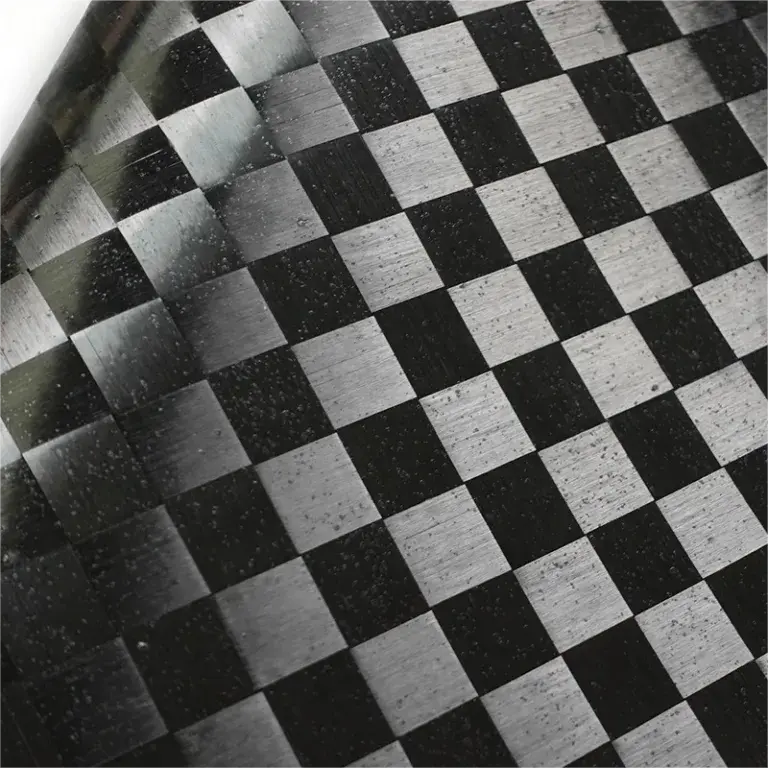
You don’t have to choose one or the other. In fact, most “expert” laminates are hybrids. A common strategy for high-end parts is the “A-Surface” vs “Bulk” approach. The outermost layer (the A-surface) is a 3K 2×2 twill, chosen for its visual appeal and fine weave. The internal structural layers (the bulk) are 12K plain weave or UD (unidirectional). This gives the customer the carbon look they expect while allowing the manufacturer to build the necessary thickness using cheaper, faster-to-lay-up 12K material.
Consider print-through when surface appearance matters. Larger 12K bundles can produce a more visible weave texture after cure. A finer cosmetic ply, surfacing veil, controlled resin-rich surface or finishing process may reduce print-through; confirm compatibility with the laminate and finish requirements. For non-cosmetic parts, a 12K layup may be suitable when the structural design and process have been validated.
Industrial Applications: Marine and Wind Energy
In the marine industry, carbon fiber is increasingly replacing fiberglass for high-performance hulls and masts. Here, 12K and even 24K “Heavy Tow” are the standard. The sheer volume of material required for a 50-foot mast makes 3K cost-prohibitive. Similarly, in wind energy, the massive spars of turbine blades are built using 12K Unidirectional (UD) carbon. The ability to source 12K at bulk pricing is what makes these large-scale composite structures economically viable compared to traditional steel or aluminum.
Processing Considerations for 12K
12K tows form larger bundles, so resin distribution and trapped air require careful control. In wet layup, a suitable laminating roller may help consolidate the fabric without distorting it. Vacuum infusion or RTM can also be appropriate, but flow media, resin viscosity, vacuum integrity and process validation determine the resulting void content.
Conclusion: The Bottom Line for Manufacturers
Scaling a composite business requires a move toward industrial-grade materials. By integrating 12K carbon fiber into your production cycle, you reduce material costs, decrease labor time, and maintain the mechanical performance your clients demand. Whether you are using traditional 12K for bulk or the new generation of spread tow for lightweight efficiency, the large tow market is where the real industrial growth is happening.


Add comment