
There’s a moment every product designer knows: you’ve engineered the part perfectly, the mechanical specs are locked, and then the client asks —can we make it look less… industrial?
That’s where jacquard carbon fiber fabric enters the conversation.
Over the past five years, demand for decorative carbon fiber with custom weave patterns has moved from niche automotive aftermarket into mainstream consumer electronics, luxury goods, and high-end sporting equipment. The buyers who figured this out early built serious competitive advantages. The ones who are figuring it out now are catching up.
This guide is written for procurement managers, product engineers, and brand sourcing teams who need to evaluate jacquard carbon fiber fabric seriously —not as a novelty, but as a production material.
What Is Jacquard Carbon Fiber Fabric, Exactly?
Standard carbon fiber fabric —plain weave, twill, satin —is woven on conventional looms where warp and weft threads follow fixed interlacing patterns. The result is structurally excellent but visually uniform.
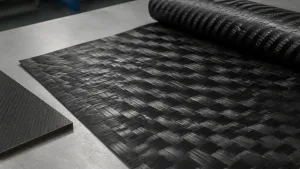
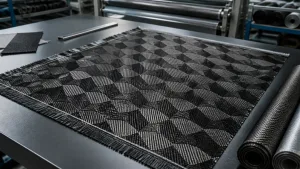
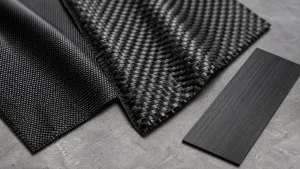
Jacquard fabric uses a computer-controlled loom mechanism (the Jacquard attachment, invented in 1804, now fully digitized) that controls each warp thread independently. This allows the weave pattern to change at every row, creating complex geometric designs, 3D surface textures, and light-reflective effects that aren’t achievable on standard looms.
When applied to carbon fiber yarns, jacquard weaving produces a material that is structurally functional (T300 or T700 carbon fiber yarns retain their tensile properties, areal weight typically 200—80 gsm), visually distinctive (surface pattern creates depth effects, metallic shimmer, or geometric contrast), and processable with standard methods including vacuum infusion, wet layup, and prepreg systems.
| Type | Characteristics | Typical Applications |
|---|---|---|
| 3D Jacquard | Raised surface texture, cubic or diamond geometry | Phone cases, automotive trim panels |
| Metallic Wire Jacquard | Carbon + metallic yarn interwoven | Luxury goods, cosmetic panels, jewelry |
| Pattern Jacquard (houndstooth, geometric) | High-contrast weave geometry | Automotive interiors, sporting goods |
| Bidiagonal Jacquard | Angled weave producing directional light play | Decorative panels, exhibition fixtures |
| Custom Jacquard | Brand-specific or proprietary pattern | OEM applications |
Why B2B Buyers Are Shifting Toward Decorative Carbon Fiber
The case is straightforward for anyone who’s tracked the materials market over the past decade.
The “performance aesthetic” has gone mainstream. Carbon fiber’s association with racing, aerospace, and premium engineering is now a design language in its own right. Consumer electronics brands, watchmakers, and luggage manufacturers actively source carbon fiber not for weight savings but for what it communicates. Jacquard patterns extend this language into territory that plain twill can’t reach.
Differentiation pressure is increasing. When every competitor is using standard 3K twill, switching to a proprietary jacquard pattern creates visual IP that’s difficult to replicate cheaply. Several brands we supply use pattern carbon fiber as a trade dress element —effectively making the material itself part of their brand identity.
Commodity pricing pressure on standard fabrics. Margins on plain 3K twill have compressed significantly over the past three years as more suppliers entered the market. Jacquard and specialty pattern fabrics maintain pricing power because the loom setup cost and technical barrier are higher.
Technical Specifications: What to Verify Before Ordering
Fiber Grade
Most decorative jacquard fabrics on the market use T300 carbon fiber —the baseline structural grade with tensile modulus around 230 GPa. This is adequate for cosmetic panels, protective cases, and non-load-bearing decorative applications. If your application involves any structural loading, confirm whether the supplier can provide T700 grade in jacquard construction. Not all mills run high-grade fiber on Jacquard looms.
Areal Weight (GSM)
Jacquard fabrics typically run 200—80 gsm due to pattern complexity. For cosmetic panels with a structural backer, 200—20 gsm is sufficient for a face sheet. For stand-alone applications, verify that the selected weight resinates properly with your epoxy system —heavier fabrics require longer wet-out time in infusion processes.
Weave Stability
Jacquard weaves, especially metallic wire variants, can experience more pattern shift during handling than standard twill. Ask your supplier about selvage type (heat-fused or woven), yarn interlocking frequency, and roll direction marking —critical for pattern-matched layups.
Wholesale Pricing: How the Numbers Actually Work
| Fabric Type | MOQ (meters) | Price Range |
|---|---|---|
| Standard 3K 240gsm Jacquard Pattern | 50m | $38—55/m |
| 3K Metallic Wire Jacquard (blue/green/copper) | 50m | $55—72/m |
| Custom Pattern Jacquard (standard pattern library) | 100m | $42—60/m |
| Custom Pattern Jacquard (proprietary design) | 200m | $48—68/m + setup fee |
Prices drop 15—5% at 500m+ volumes. Most B2B buyers running production programs negotiate quarterly framework agreements with fixed pricing for the quarter based on projected volume.
Evaluating Suppliers: Six Questions That Separate Mills from Traders
- Do they weave in-house, or do they outsource Jacquard production? A mill can tell you their Jacquard loom count, the fiber brands they use, and their quality control process per batch. A trader typically cannot.
- Can they provide batch-level material evidence? For structural-grade material, request a current data sheet and, where available, an applicable batch test report or certificate of analysis. Confirm the test method, specimen, lot and issuing laboratory; a generic supplier badge is not evidence of tensile strength, modulus or elongation.
- What’s the minimum pattern customization run? Serious mills typically require 200—00m for custom work. Lower MOQs are possible for patterns already in their design library.
- What’s their defect rate and inspection protocol? A 0.5—% defect rate is normal for jacquard; anything higher suggests quality control issues.
- What resin systems have they validated? Some decorative fabrics perform poorly in infusion due to tight weave density preventing resin flow.
- Can they support OEM/private label? For brands building proprietary pattern carbon fiber into their product identity, can the supplier sign an exclusivity agreement for a specific pattern?
Processing Notes for Fabricators
Cutting: Use sharp rotary cutters or CNC waterjet. Apply cutting sealant to edges before layup —fraying is higher in jacquard weaves than standard twill.
Pattern alignment: Establish a reference corner and cut consistently from the same roll direction for cosmetic parts where visual consistency matters.
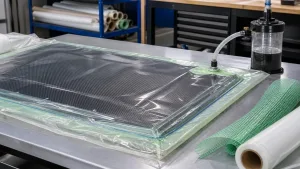
Resin wet-out: Metallic wire jacquard fabrics take slightly longer to fully wet out. Allow 10—5% additional infusion time in vacuum infusion setups. In wet layup, work resin in from the back face first.
Ordering Process at BulkComposites
We carry 14+ decorative carbon fiber variants in stock, including jacquard, metallic wire, geometric, and hybrid carbon-Kevlar constructions. All stock items ship within 48 hours.
For standard in-stock patterns: Minimum order 5m (sample qualification), 50m (wholesale). Lead time: 48h dispatch from warehouse.
For custom pattern development: Minimum custom run 200m. Development lead time 4— weeks from pattern approval. Submit a pattern brief or reference image to info@bulkcomposites.com.
Sample requests: Email info@bulkcomposites.com with your application description. We send 1—m samples for qualification before bulk orders.
Key Takeaways for B2B Sourcing Teams
- Jacquard carbon fiber is a production material, not a novelty —T300 grade handles cosmetic panel requirements with no mechanical compromise.
- Supplier qualification matters more than in standard carbon —verify in-house weaving capability before committing to production volumes.
- Custom patterns are viable at 200m+ —for brands building pattern carbon into their product identity, the economics work at moderate volumes.
- Resin system compatibility needs confirmation —especially for metallic wire variants in infusion processes.
- Pricing has held better than commodity carbon —decorative fabrics maintain margin; standard twill has commoditized.
Related reading: Wholesale Guide: 3K vs 12K Carbon Fiber Fabric | Decorative Carbon Fiber Fabric —Full Range
BulkComposites has supplied structural and decorative carbon fiber fabrics to automotive, electronics, and consumer goods manufacturers since 2010. Factory-direct pricing. Ships to 50+ countries.

Add comment