
Welcome to the Aramid Fiber Performance Handbook, your comprehensive guide to understanding the exceptional capabilities of aramid fiber, particularly its heat resistance and impact performance. This handbook is designed to provide you with a thorough understanding of aramid fiber properties and its applications.
In this first section, we introduce the importance of aramid fiber and its growing relevance across various industries. With its unique properties, aramid fiber has become a critical material in many applications, offering exceptional heat resistance and impact resistance.
Key Takeaways
- Understanding the properties of aramid fiber
- The significance of heat resistance in aramid fiber applications
- The role of impact resistance in various industries
- Growing relevance of aramid fiber across different sectors
- Comprehensive overview of aramid fiber performance
What is Aramid Fiber?
Aramid fiber, characterized by its aromatic polyamide structure, offers a combination of high strength, low weight, and thermal stability. This synthetic material is known for its exceptional performance in various applications, from protective clothing to advanced composites.
Chemical Composition and Molecular Structure
Aramid fibers are synthetic polymers composed of aromatic polyamides. Their molecular structure is characterized by rigid, rod-like molecules that are highly aligned in the fiber direction, contributing to their exceptional strength and stiffness. The chemical composition of aramid fibers typically involves a condensation reaction between an aromatic diamine and an aromatic diacid chloride.
Historical Development and Commercial Evolution
The development of aramid fiber began with significant milestones in research and commercialization. Understanding its history provides insight into its current applications and future potential.
Early Discoveries and Patents
The first aramid fibers were developed in the 1960s by DuPont, with the introduction of Nomex in 1961 and Kevlar in 1971. These early developments were crucial in establishing aramid fibers as high-performance materials.
Modern Manufacturing Milestones
Over the years, manufacturing processes have evolved, improving the quality and reducing the cost of aramid fibers. Modern techniques enable the production of high-quality fibers with consistent properties.
| Year | Milestone | Manufacturer |
|---|---|---|
| 1961 | Introduction of Nomex | DuPont |
| 1971 | Introduction of Kevlar | DuPont |
| 1980s | Advancements in manufacturing techniques | Various |
Essential Properties of Aramid Fiber
Aramid fiber is renowned for its exceptional mechanical properties, making it a critical material in various high-performance applications. Its unique characteristics have led to its widespread use in industries requiring high strength, resistance to heat, and durability.
Tensile Strength and Modulus Characteristics
Aramid fiber boasts high tensile strength and modulus, making it suitable for applications where resistance to deformation is crucial. The tensile strength of aramid fiber is significantly higher than many other materials, providing a reliable performance under stress.
Density and Weight-to-Strength Ratio
The density of aramid fiber is relatively low, which contributes to its high weight-to-strength ratio. This property is particularly valuable in applications where weight reduction is essential without compromising on strength.
Chemical and Environmental Resistance
Aramid fiber exhibits excellent resistance to a wide range of chemicals and environmental factors. This resistance is crucial for its performance and longevity in various applications.
Acid and Alkali Resistance
Aramid fiber shows a high degree of resistance to both acids and alkalis, although its performance can vary depending on the concentration and temperature of the exposure. This resistance is a key factor in its suitability for use in harsh environments.
UV and Weather Degradation
While aramid fiber has good resistance to many chemicals, it can be susceptible to degradation from UV radiation and weathering. Proper treatment or coating can enhance its durability against these factors.
| Property | Aramid Fiber | Comparison Material |
|---|---|---|
| Tensile Strength | High | Moderate |
| Density | Low | High |
| Chemical Resistance | Excellent | Good |
Heat Resistance Performance
Aramid fiber’s ability to withstand high temperatures without compromising its integrity is a key characteristic that sets it apart from other materials. This exceptional heat resistance makes aramid fiber a preferred choice in various high-temperature applications.
Maximum Temperature Thresholds
Aramid fiber can operate effectively at temperatures significantly higher than those tolerated by many other synthetic fibers. Its maximum temperature threshold is a critical factor in its selection for applications requiring thermal stability.
Thermal stability is maintained through its molecular structure, which resists degradation at elevated temperatures. This property is crucial for industries such as aerospace and automotive, where materials are exposed to extreme heat.
Thermal Degradation Mechanisms
The thermal degradation of aramid fiber occurs through complex mechanisms involving the breakdown of its molecular structure. Understanding these mechanisms is essential for predicting the material’s performance under various thermal conditions.
Thermal analysis techniques are used to study the degradation process, providing insights into the material’s thermal stability and helping to optimize its use in high-temperature environments.
Flame Retardant Properties and Self-Extinguishing Behavior
Aramid fiber is inherently flame retardant, a property that contributes to its safety and reliability in applications where fire risk is a concern. Its self-extinguishing behavior is characterized by its ability to cease burning once the ignition source is removed.
Limiting Oxygen Index (LOI) Values
The LOI value is a measure of the minimum oxygen concentration required to sustain combustion. Aramid fiber has a high LOI, indicating its resistance to burning and its self-extinguishing capability.
Char Formation and Protective Barriers
Upon exposure to flame, aramid fiber forms a char that acts as a protective barrier, shielding the underlying material from further thermal degradation. This char formation is a critical aspect of its flame retardant properties.
The combination of high thermal stability, flame retardancy, and self-extinguishing behavior makes aramid fiber an ideal material for demanding applications where heat resistance is paramount.
Impact Resistance and Energy Absorption Capabilities
Aramid fiber’s unique properties enable it to absorb energy effectively, making it ideal for ballistic protection. Its impact resistance and energy absorption capabilities are critical in various applications, from personal protective gear to industrial uses.
Ballistic Performance Metrics and Standards
The ballistic performance of aramid fiber is measured using specific metrics and standards. These include the National Institute of Justice (NIJ) standards for body armor, which classify ballistic resistance based on the type of ammunition and the velocity of the projectile. Aramid fiber composites are tested for their ability to stop various threats, and their performance is evaluated based on metrics such as the backface deformation and the number of layers required to stop a projectile.
| NIJ Standard | Threat Level | Typical Application |
|---|---|---|
| NIJ II | 9mm FMJ | Soft body armor |
| NIJ IIIA | .44 Magnum | Soft body armor |
| NIJ III | 7.62mm FMJ | Rifle plates |
Energy Dissipation Mechanisms
Aramid fiber dissipates energy through various mechanisms, including fiber breakage, matrix cracking, and delamination. The efficiency of energy dissipation is influenced by the fiber’s tensile strength, modulus, and the interfacial bonding between the fiber and the matrix. Effective energy dissipation is crucial for minimizing the impact on the protected object or person.
Dynamic Loading Response
The dynamic loading response of aramid fiber is characterized by its ability to withstand high-velocity impacts. This response is influenced by the fiber’s viscoelastic properties and its ability to deform under stress.
High-Velocity Impact Behavior
Under high-velocity impact, aramid fiber exhibits a complex behavior characterized by rapid deformation and energy absorption. The fiber’s ability to withstand such impacts is critical in ballistic protection applications.
Low-Velocity Impact Characteristics
In contrast, low-velocity impacts result in different failure modes, often involving matrix cracking and delamination. Understanding these characteristics is essential for designing composite materials for applications where low-velocity impacts are expected.
Major Types of Aramid Fiber
The versatility of aramid fibers is reflected in their various types, including para-aramid and meta-aramid variants. Aramid fibers are not a single, uniform material; instead, they encompass a range of types and variants, each with its unique properties and applications.
Para-Aramid Variants
Para-aramid fibers, such as Kevlar, Twaron, and Heracron, are known for their exceptional tensile strength and resistance to heat and abrasion. These fibers are used in demanding applications, including ballistic protection and high-performance composites.
Meta-Aramid Variants
Meta-aramid fibers, including Nomex and Teijinconex, offer excellent thermal stability and flame resistance. They are commonly used in protective clothing, insulation, and other applications where heat resistance is critical.
Specialty and Hybrid Formulations
In addition to para-aramid and meta-aramid fibers, there are specialty and hybrid aramid formulations designed for specific applications. These may include blends with other fibers or modified versions of aramid fibers with enhanced properties.
| Type | Examples | Key Properties |
|---|---|---|
| Para-Aramid | Kevlar, Twaron, Heracron | High tensile strength, heat resistance |
| Meta-Aramid | Nomex, Teijinconex | Thermal stability, flame resistance |
| Specialty/Hybrid | Blends and modified aramid | Enhanced properties for specific applications |
Understanding these different types of aramid fibers is essential for selecting the right material for specific applications, from protective gear to high-performance composites.
Manufacturing and Processing Techniques
Aramid fiber manufacturing is a sophisticated process that includes several critical steps, from initial fiber spinning to final post-processing treatments. The quality of the final product depends on the precision and control exercised during these stages.
Fiber Spinning Methods
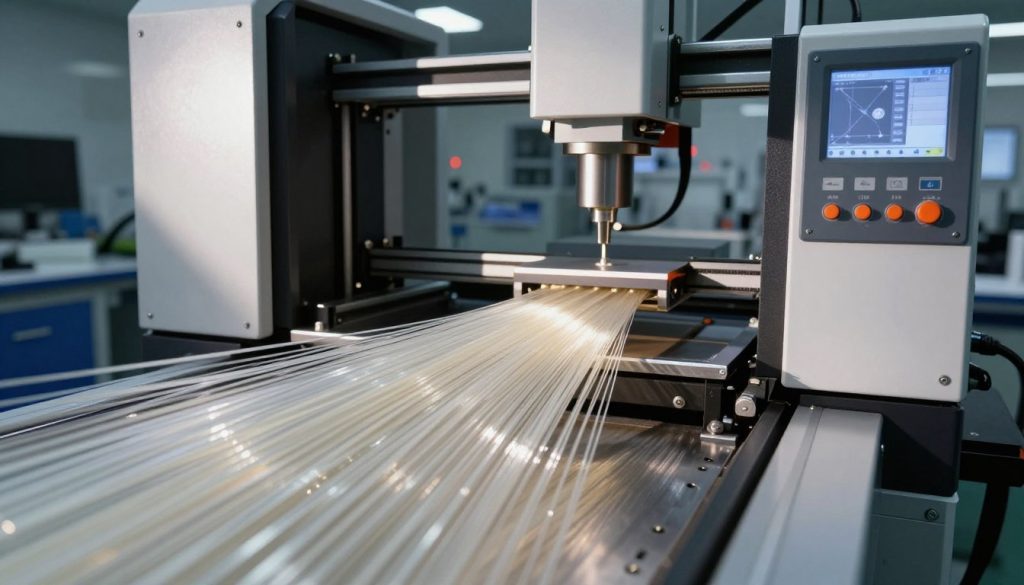
The production of aramid fibers begins with fiber spinning, a process that involves extruding a polymer solution through a spinneret to create filaments. Para-aramid fibers, like Kevlar, are produced using a wet spinning process, where the polymer is dissolved in a solvent and then coagulated in a bath. In contrast, meta-aramid fibers, such as Nomex, are often produced through dry spinning, where the solvent is evaporated, leaving behind the fiber.
Post-Processing and Finishing Treatments
After spinning, aramid fibers undergo various post-processing treatments to enhance their properties. These treatments can include drawing, where the fibers are stretched to align the molecular structure, and heat treatment, which improves the fiber’s thermal stability. Additional finishing treatments, such as coating or washing, may be applied to achieve specific surface properties or to remove impurities.
Quality Control and Testing During Production
To ensure the consistency and reliability of aramid fiber products, rigorous quality control measures are implemented throughout the manufacturing process. This includes testing for tensile strength, thermal resistance, and other critical properties. By maintaining high standards of quality control, manufacturers can guarantee that their aramid fibers meet the required specifications for various applications.
Commercial Applications of Aramid Fiber
With its outstanding performance characteristics, aramid fiber is utilized in a broad range of applications, from protective gear to advanced industrial components. Its unique blend of strength, heat resistance, and lightweight properties makes it an ideal material for various industries.
Personal Protective Equipment
Aramid fiber is extensively used in personal protective equipment (PPE) due to its exceptional ballistic resistance and heat resistance. This includes:
Ballistic Vests and Helmets
Aramid fiber-based ballistic vests and helmets provide critical protection for military and law enforcement personnel. The material’s high tensile strength and ability to absorb impact energy make it effective against various threats.
Firefighting Gear
Firefighters rely on aramid fiber-based gear for its thermal protection and durability. The material’s resistance to high temperatures and flames helps safeguard against burn injuries.
Aerospace and Automotive Components
In the aerospace industry, aramid fiber is used in the manufacture of lightweight, high-strength components, such as aircraft parts and satellite structures. In automotive applications, it’s used for reinforced tires and other high-performance parts.
Industrial Applications and Infrastructure
Aramid fiber’s durability and resistance to degradation make it suitable for various industrial applications, including reinforced composites for construction and infrastructure projects. It’s also used in cables and optical fibers.
Consumer and Sporting Goods
Beyond industrial and protective applications, aramid fiber is found in consumer and sporting goods, such as high-performance sports equipment and protective gear for athletes. Its use enhances the safety and performance of these products.
The versatility of aramid fiber is a testament to its exceptional properties, making it a valuable material across multiple sectors.
Performance Testing and Standards
Generic references to testing do not guarantee the safety or effectiveness of an aramid product. Define the end-use hazard and applicable standard first, then review a report that identifies the tested product, conditioning, method, laboratory, results and limitations.
Heat Resistance Testing Protocols
Heat resistance is a critical property of aramid fiber, and several testing protocols are used to assess this characteristic. Two key tests are:
Thermal Protective Performance (TPP)
The TPP test measures the material’s ability to protect against thermal hazards, such as flames or high-temperature surfaces. It evaluates the time it takes for the material to transfer heat and cause a second-degree burn.
Continuous Operating Temperature Tests
These tests determine the maximum temperature at which aramid fiber can operate continuously without degrading. This is crucial for applications where the material is exposed to high temperatures for extended periods.

Impact and Ballistic Testing Methods
Aramid fiber is often used in applications requiring high impact and ballistic resistance, such as body armor. Testing methods for these properties include:
- Ballistic impact tests to assess the material’s ability to stop projectiles
- Drop weight impact tests to evaluate energy absorption
Application-Specific Standards and Evidence
Requirements depend on the finished product, hazard, market and jurisdiction. A fiber or fabric data sheet is not approval for body armor, firefighting gear, respiratory protection or other safety-critical equipment, and NIOSH is not a universal approval body for all protective clothing.
For safety-critical use, obtain current documents naming the tested finished product, test method, laboratory, revision, pass criteria and intended use. A qualified engineer or safety professional should confirm that the evidence matches the actual design and jurisdiction.
Aramid Fiber Compared to Competing Materials
The comparison between aramid fiber and other high-performance materials is crucial for selecting the right material for specific applications. Aramid fiber is often evaluated against carbon fiber, fiberglass, and ultra-high-molecular-weight polyethylene (UHMWPE) due to their overlapping applications in various industries.
Versus Carbon Fiber Composites
Aramid fiber and carbon fiber composites have different properties. While carbon fiber excels in stiffness and compressive strength, aramid fiber offers superior impact resistance and flexibility. This makes aramid fiber ideal for applications requiring energy absorption, such as ballistic protection.
Versus Fiberglass Reinforcements
Fiberglass is another common reinforcement material. Compared to aramid fiber, fiberglass has lower tensile strength and is more prone to damage from environmental factors. However, it is generally less expensive, making it a cost-effective option for less demanding applications.
Versus Ultra-High-Molecular-Weight Polyethylene (UHMWPE)
UHMWPE is known for its high impact resistance and low density. While it shares some similarities with aramid fiber in terms of ballistic performance, aramid fiber typically offers better thermal stability and resistance to higher temperatures.
Cost-Benefit Analysis Across Applications
When choosing between aramid fiber and competing materials, a cost-benefit analysis is essential. The table below summarizes key factors to consider:
| Material | Tensile Strength | Impact Resistance | Cost |
|---|---|---|---|
| Aramid Fiber | High | Excellent | Moderate |
| Carbon Fiber | Very High | Poor | High |
| Fiberglass | Moderate | Fair | Low |
| UHMWPE | High | Excellent | High |
In conclusion, aramid fiber offers a unique combination of properties that make it suitable for a wide range of applications, particularly where impact resistance and thermal stability are critical.
Working with Aramid Fiber: Practical Considerations
To fully leverage the benefits of aramid fiber, understanding the practical considerations for working with this material is essential. Aramid fiber is used in a variety of demanding applications, from personal protective equipment to aerospace components, due to its exceptional strength, heat resistance, and durability.
Cutting and Machining Techniques
Cutting and machining aramid fiber require specialized techniques to prevent damage and ensure precision. Laser cutting and water jet cutting are commonly used methods, as they provide clean cuts without generating excessive heat, which can degrade the material.
Joining and Bonding Methods
Joining and bonding aramid fiber materials can be challenging due to their chemical resistance and surface properties. Techniques such as adhesive bonding, using specially formulated adhesives, and mechanical fastening are employed to achieve strong and reliable joints.
Handling Precautions and Safety Measures
Handling aramid fiber requires precautions to minimize exposure to dust and prevent skin contact. Dust control measures, including ventilation systems and dust collection equipment, are crucial in work environments.
Dust Control and Respiratory Protection
Effective dust control is vital when working with aramid fiber to prevent inhalation of fibers, which can cause respiratory issues. Respiratory protection equipment, such as masks and respirators, should be used in conjunction with dust control measures.
Skin Contact Considerations
While aramid fibers are generally considered to be less irritating than some other high-performance fibers, skin contact should still be minimized. Wearing protective clothing, including gloves, is recommended to prevent skin irritation.
| Safety Measure | Purpose | Implementation |
|---|---|---|
| Dust Control Systems | Minimize airborne fibers | Install ventilation and dust collection systems |
| Respiratory Protection | Prevent inhalation of fibers | Use masks and respirators |
| Protective Clothing | Prevent skin contact | Wear gloves and protective garments |
Conclusion
Aramid fiber has proven to be a highly versatile and valuable material across various industries, from personal protective equipment to aerospace and industrial applications. Throughout this handbook, we have explored the properties, manufacturing processes, and applications of aramid fiber, as well as its comparison to other materials and practical considerations for working with it.
The unique combination of heat resistance, impact resistance, and energy absorption capabilities makes aramid fiber an ideal choice for demanding applications. As industries continue to evolve and new technologies emerge, the potential for aramid fiber to drive innovation and improvement is vast.
In summary, aramid fiber is a high-performance material that offers a range of benefits and opportunities for various sectors. As we conclude this handbook, it is clear that aramid fiber will remain a critical component in the development of advanced materials and technologies.
FAQ
What is aramid fiber, and what are its primary uses?
Aramid fiber is a high-performance synthetic fiber known for its exceptional heat resistance, impact resistance, and tensile strength. It is used in various applications, including personal protective equipment, aerospace, automotive, and industrial components.
How does aramid fiber perform under high-temperature conditions?
Aramid fiber has a high thermal stability and can withstand extremely high temperatures without losing its structural integrity. It is often used in applications requiring heat resistance, such as firefighting gear and heat shields.
What are the different types of aramid fiber, and how do they differ?
The main types of aramid fiber are para-aramid (e.g., Kevlar, Twaron) and meta-aramid (e.g., Nomex). Para-aramid fibers are known for their high tensile strength and ballistic resistance, while meta-aramid fibers are valued for their thermal stability and flame resistance.
How is aramid fiber manufactured, and what are the key processing techniques?
Aramid fiber is manufactured through a process involving the spinning of a polymer solution into fibers, followed by various post-processing treatments to enhance its properties. Techniques such as drawing and heat treatment are used to achieve the desired mechanical properties.
What are the advantages of using aramid fiber in personal protective equipment?
Aramid fiber provides excellent protection against heat, flames, and impact due to its high thermal stability, flame resistance, and energy absorption capabilities. It is widely used in ballistic vests, helmets, and firefighting gear.
How does aramid fiber compare to other high-performance materials like carbon fiber and UHMWPE?
Aramid fiber offers a unique combination of properties, including heat resistance, impact resistance, and tensile strength. While it may not excel in every category compared to materials like carbon fiber or UHMWPE, its balanced performance makes it suitable for a wide range of applications.
What are the safety considerations when working with aramid fiber?
When handling aramid fiber, it is essential to minimize exposure to dust, as it can cause respiratory issues. Proper ventilation, respiratory protection, and skin protection are recommended to ensure safe handling.
Can aramid fiber be used in composite materials, and what are the benefits?
Yes, aramid fiber can be used in composite materials, often combined with resins or other fibers. The benefits include enhanced mechanical properties, such as improved impact resistance and tensile strength, making it suitable for demanding applications.

Add comment